Recently I needed to align my CNC router spindle to the table. Part of doing this involved tapping on metal parts here and there. Not wanting to damage them, I needed a “soft” hammer to use, so I quickly made a brass hammer.


Recently I needed to align my CNC router spindle to the table. Part of doing this involved tapping on metal parts here and there. Not wanting to damage them, I needed a “soft” hammer to use, so I quickly made a brass hammer.
A closeup of Brazilian Cherry (Jatoba) and Maple.

Here is a little robot the kids and I were working on.
We designed it in Solidworks.

Prepared for printing in the MakerWare software.
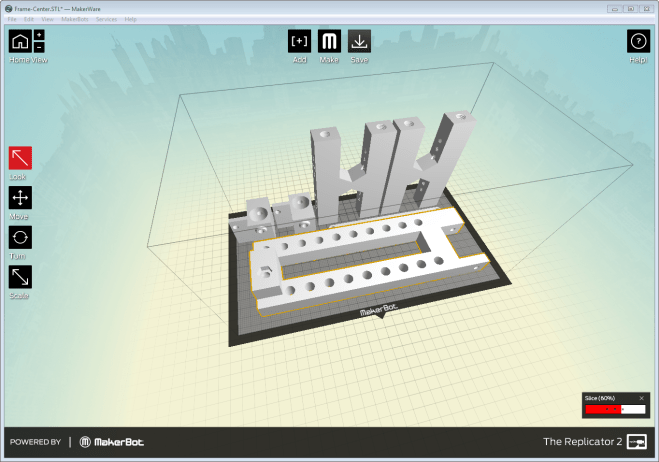
Printed it on the MakerBot. It failed halfway through and we had to re-print some of the parts.

Here is a closeup of the print.

And some pictures of the finished chassis.

We used custom rubber bands for tires. Threads were even printed into some of the parts so 6mm bolts could screw right in.

3D Rendering has always interested me, but I’ve never taken the time to mess around with it much.
When I was a kid I used to do stuff like this in Basic. But I didn’t know trig or other similar functions so I was left to basic math and the random functions.
Here is a little turtle program (python) that will make a wrinkled fabric type display.


Here are a couple of pictures of large pinecones made out of soft maple.
They were carved on the CAMaster CNC Router and finished by hand.


At Sinking Valley Woodworks, we take on odd jobs from time to time. One of these odd jobs was some car parts for an old Bentley restoration. Wood was a much more common material in cars in that era.
This particular piece is what goes at the top of the windshield and connects to the roof. It has curves on all faces, and compound curves on most. The new part was made out of Ash, carved on a CNC router, and finished by hand.
Below is some before and after pictures.


Anna got to go for a ride the other day. She made it look good!

Here is a closeup of a 3D printed chess piece. We designed them in solidworks and printed them using a MakerBox Replicator 2 with PLA plastic. It’s on the chess board dining room table.

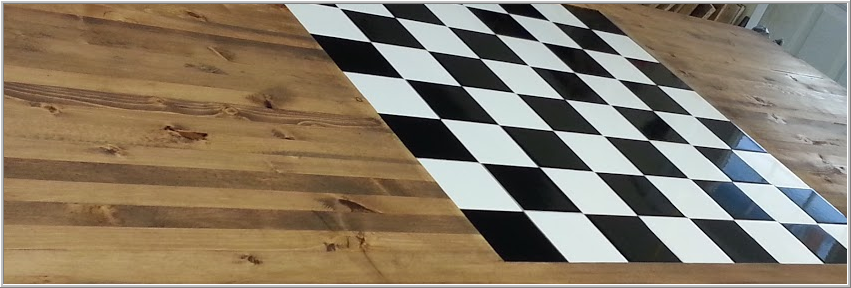
Here is the chess “board”

Here are the ceramic tiles going into the chess table before the bar top was applied:

Here are a couple of pictures of a recent Sinking Valley Woodworks project: a Brazilian Cherry Butcher Block Cutting Board.
It’s solid end-grain, glued up with Titebond Ultimate, and sanded down to 2000 grit. It simply has mineral oil – the gloss is from the wood itself.
What do you think?
Here is the finished product.

Notice how glossy the top is? That’s what happens when you take Brazilian Cherry end grain to 2000 sanding.

The swirls in the grain pattern were intentional. As the pieces were glued up, the grain was alternated creating a very neat final pattern.

Here is a closeup of the grain.

This is prior to any mineral oil being applied. Notice the reflection of the light that is 9′ above the surface.

I-Beam clamps. They are great.

 The Gahooa Perspective