More wooden pegs

We’ve been refining the art of driving wooden pegs.  By the way, if you get a high end cordless drill, I recommend Hitachi over  Porter Cable.  The proter cable (18V Lithium) didn’t have the power, or battery life to drill these holes, and the gear box eventually stripped out.

The Hitachi drill powers right through and keeps going.  Even it’s drill setting will “slip” if subject to too much torque, but it seems to be a reasonable point that is adequate for heavy duty drilling.


Making a “working” toy shotgun

Some time ago, Eli asked me to build a toy shotgun.  We wanted something that would give a real “bang”, but be simple and safe.

Provided that a large mass of metal was collided into another at sufficient speed, the user would experience both a “bang” and a “kick” (although inverse).

We milled, drilled, and fit a bolt into a square aluminum tube.  A spring connected the front of the bolt to the front of the tube.  When the bolt was retracted and released, it would collide into the square tube with the desired effect.


The end result is here:

And, enjoy the pictures.


A big measuring tape and a right triangle

Just a good picture of Eli (with Ezra and Anna in the background) holding a 300′ measuring tape.

We needed to make a right angle, so I explained to them that a triangle with the sides

3, 4, 5

will be a 100% right triangle.  So we measured 15′, 20′, and 25′ around three stakes, and that is how we got our right angle :)

For anyone who has been out of high-school long enough to forget, the equation is:

A*A + B*B = C*C

That is…

3*3 + 4*4 = 5*5
9 + 16 = 25
25=25
True

See more about Pythagoras and his Pythagorean Theorem at Wikipedia…

A better way to hold metal inventory

For a couple years now, my growing collection of dimensional metalic material has been piled on the end of my workbench. Not good for finding it, keeping it clean, rust free, or straight. Plus, I cannot make full use of my workbench.

Here is what 100′ of PVC pipe cut into 3′ lengths can do…

Now, I just need to build a rack for the pipe to set in, move it off my bench, and I’ll be set (for now).  Easy to expand, though.

And a great helper!

A square peg in a round hole?

Yep.  We are building a rough wooden table out of the trees we cut down for a clearing on our land.  Rather than use screws or nails or saws, we opted for the axe, drilling holes, and wooden pegs.

Actually, almost all of the wood pictured was cut with a Friskars Chopping Axe.  Eventually, I got tired of chopping and purchased a nice Stihl chainsaw to help out.  Regardless, the hewing and fitting is still done with the axe.

The top boards are half-logs of a maple tree.  The pegs, also, are green maple, that we squared off with a knife and pounded into 1″ holes.

Rubber Band Gun #6 – four pieces explained

I spent a bit of time this evening taking measurements and verifications, adding pin holes, and communicating with Dixon Tool and Die about pricing, etc…

Here are the 4 key parts in the design:

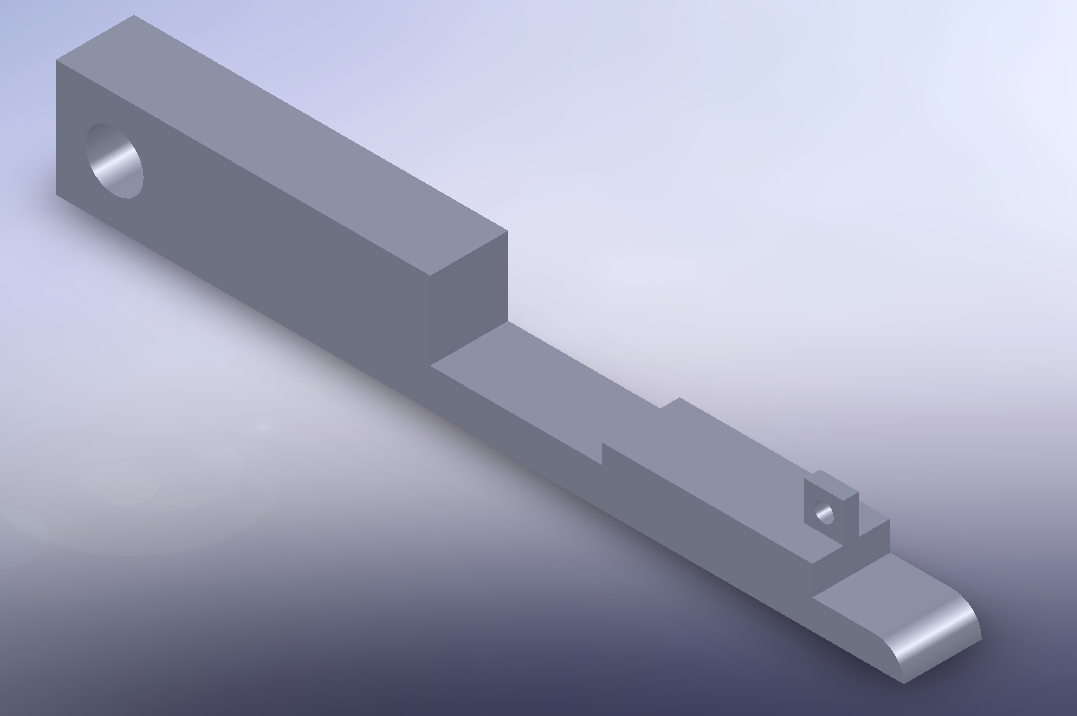
Trigger: Pivots on a 3/16″ dowel pin.  As the trigger is pulled, the two protrusions from the front move downward into the actuators.  The one side is milled out 1/16″ deeper than the other, so that the one side of the rubber band gun fires before the other.  A 2 stage trigger.

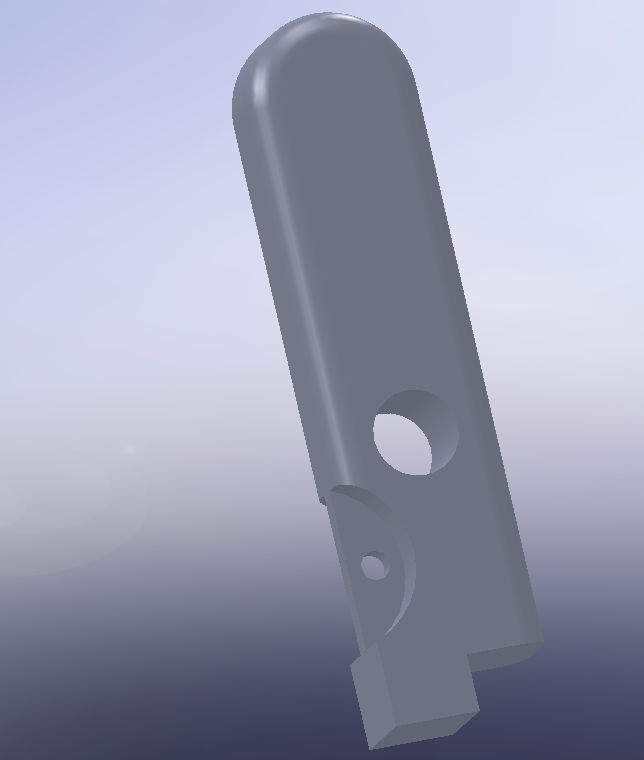
Hammer: The hammer is not a hammer in the sense that it strikes something, but only in that it resembles the hammer from a gun.  It pivots on a 3/16″ dowel pin.  At the bottom is a milled out section directly below the pivot point, providing for a linear, smooth release.  The notch and hole on the front are used to attach a spring, which provides an automatic-reset for the hammer.

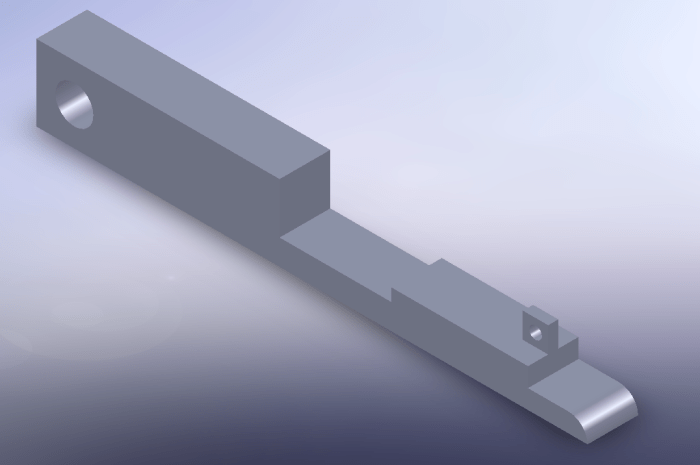
Actuator: Because I couldn’t think of a better name at the time.  This is the piece which holds the hammer from being released, and also contacts the trigger, both providing a linkage to be released, as well as spring tension up on the trigger.  Since the trigger does not have a spring, it relies on the contact from this part to provide springiness.
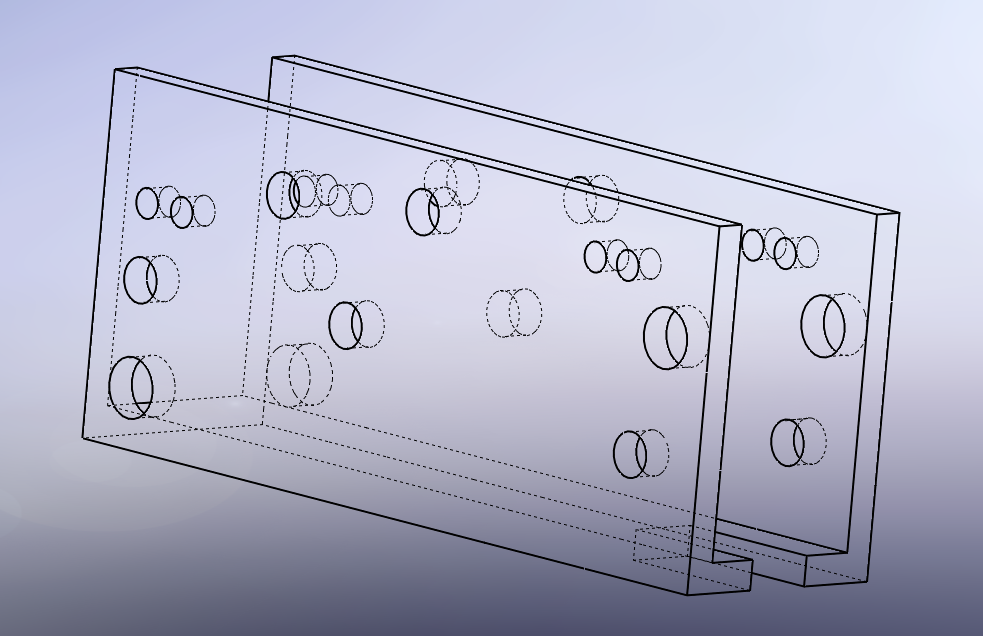
Receiver: For simplicity, this is milled and drilled from a 1.000 x 1.500 aluminum tube with 0.125″ thick walls.  It is responsible for holding pins, which in turn hold the rest of the parts.

Well, that’s all for now.