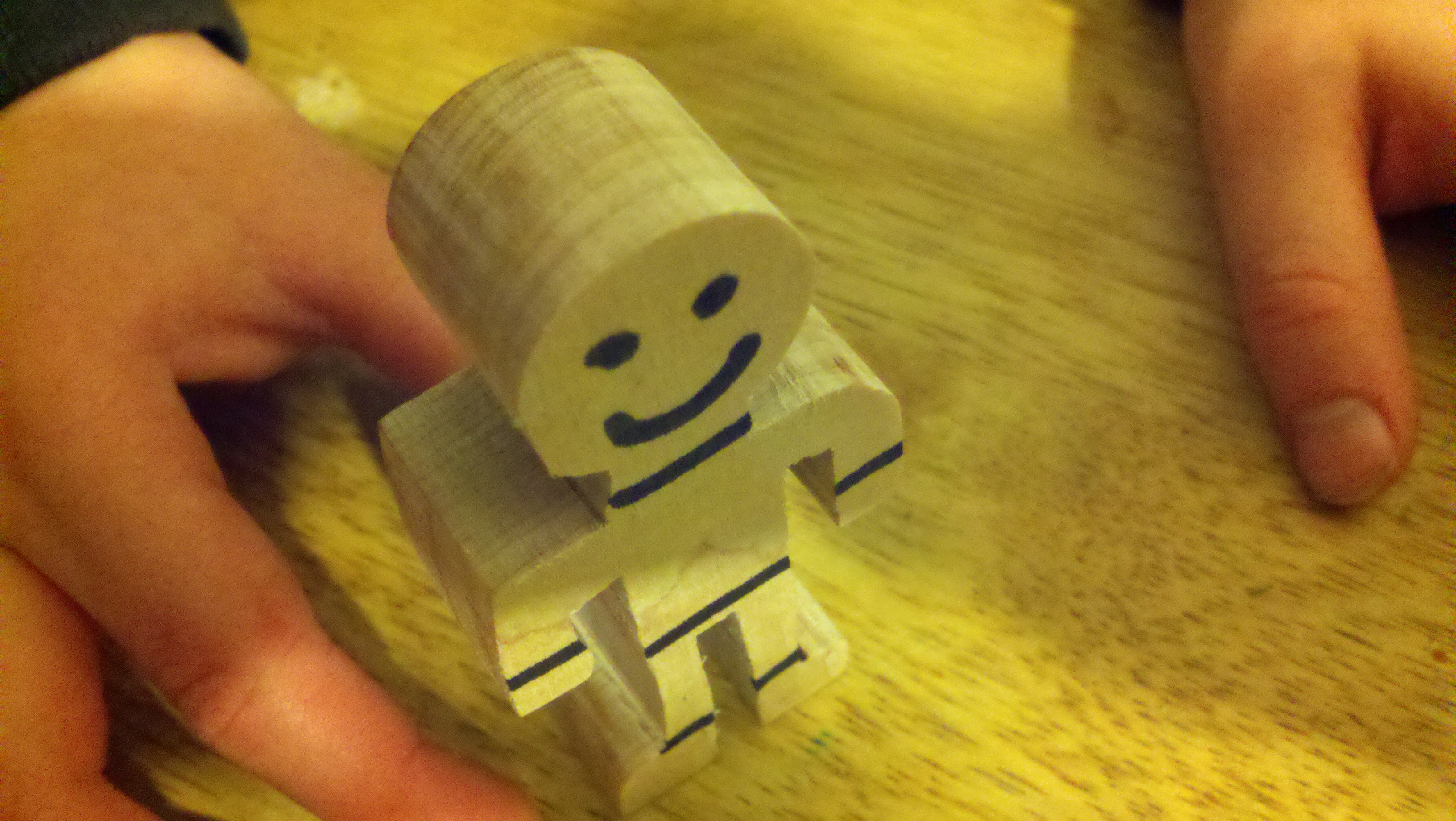
We now have a small family of four EzMobile. Kids love them, despite their rough construction. The great part is that I only have a few minutes in each one despite a dull bandsaw blade.


We now have a small family of four EzMobile. Kids love them, despite their rough construction. The great part is that I only have a few minutes in each one despite a dull bandsaw blade.
After a long wait, we have finally finished the first of a limited production run of Rubber Band Gun #6… It works great!


I have a theory that it’s the adults that think the fancy plastic toys are somehow cooler than their simple counterparts. Kids on the other hand are using their imagination (at least should be), and don’t really care how pixel-perfect it is.
My theory was verified when 5 minutes after taking this photo, Ezra flew a $15 toy helicopter past me with this little EzMobile guy hanging out the door :)


Salt! Looks pretty cool up close.

I like close ups… I took this a few years ago on my dinner table.

We were using a bunsen burner hooked up to a propane tank to heat a spoon, and the salt in the spoon, red hot in order to melt the salt.
According to the wikipedia article on salt, the melting point is 1474 °F. See further comments after this picture…

It took a while, but we did get it to melt. I “poured” it onto a metal surface, and you can see it still glowing here:

And for reference, here is what a Sodium Chloride crystal looks like up close:

We’ve been refining the art of driving wooden pegs. By the way, if you get a high end cordless drill, I recommend Hitachi over Porter Cable. The proter cable (18V Lithium) didn’t have the power, or battery life to drill these holes, and the gear box eventually stripped out.
The Hitachi drill powers right through and keeps going. Even it’s drill setting will “slip” if subject to too much torque, but it seems to be a reasonable point that is adequate for heavy duty drilling.

Some time ago, Eli asked me to build a toy shotgun. We wanted something that would give a real “bang”, but be simple and safe.
Provided that a large mass of metal was collided into another at sufficient speed, the user would experience both a “bang” and a “kick” (although inverse).
We milled, drilled, and fit a bolt into a square aluminum tube. A spring connected the front of the bolt to the front of the tube. When the bolt was retracted and released, it would collide into the square tube with the desired effect.
And, enjoy the pictures.


Yep. We are building a rough wooden table out of the trees we cut down for a clearing on our land. Rather than use screws or nails or saws, we opted for the axe, drilling holes, and wooden pegs.
 Actually, almost all of the wood pictured was cut with a Friskars Chopping Axe. Eventually, I got tired of chopping and purchased a nice Stihl chainsaw to help out. Regardless, the hewing and fitting is still done with the axe.
The top boards are half-logs of a maple tree. The pegs, also, are green maple, that we squared off with a knife and pounded into 1″ holes.


I visited Dixon Tool and Die, Inc. today to see about having some machining done. Bill Dixon Jr. was very helpful, and explained many of the points that will make the process go easier.
To that end, I did a bit of springy research, and found that neither McMaster Carr or Manhattan Supply Co. had really small springs in bulk (only precision (eg expensive) springs in those sizes).
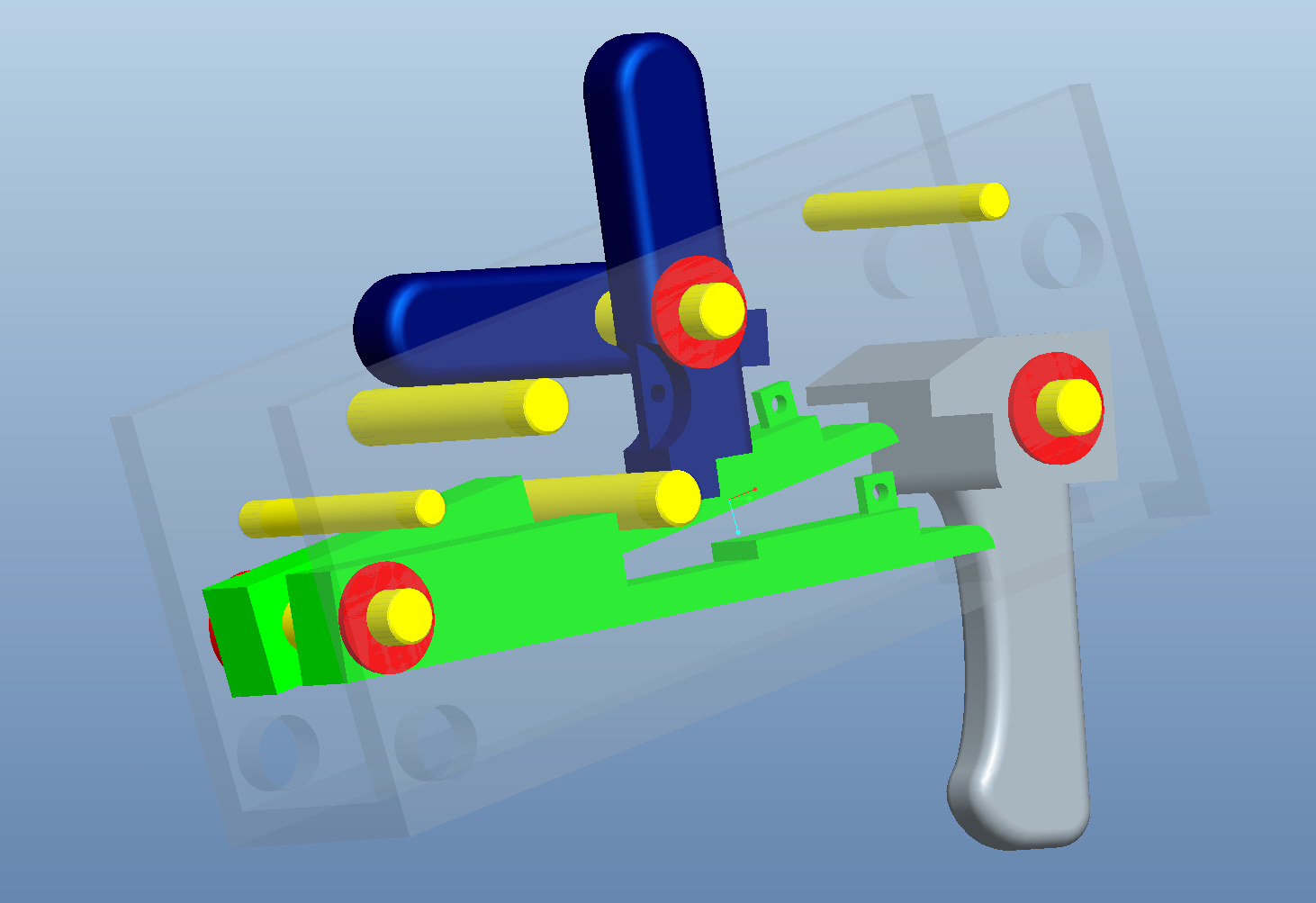
So I re-placed one of the pins to fit a standard (cheap) McMaster spring, and got pricing from http://centuryspring.aitrk.com/products/extension.html for a special spring. The trigger spring has ~ a 2/1 leverage (finger/spring), so we need to have several lbs of spring pull to equal a decent trigger pull. They have a spring with these dimensions:
While $1.20 is more than I wanted to pay, it sure beats $2.00 to $3.00 per spring that I was looking at from McMaster.
With a shorter spring, I was able to re-design the pin placement, which resulted in this:


 The Gahooa Perspective